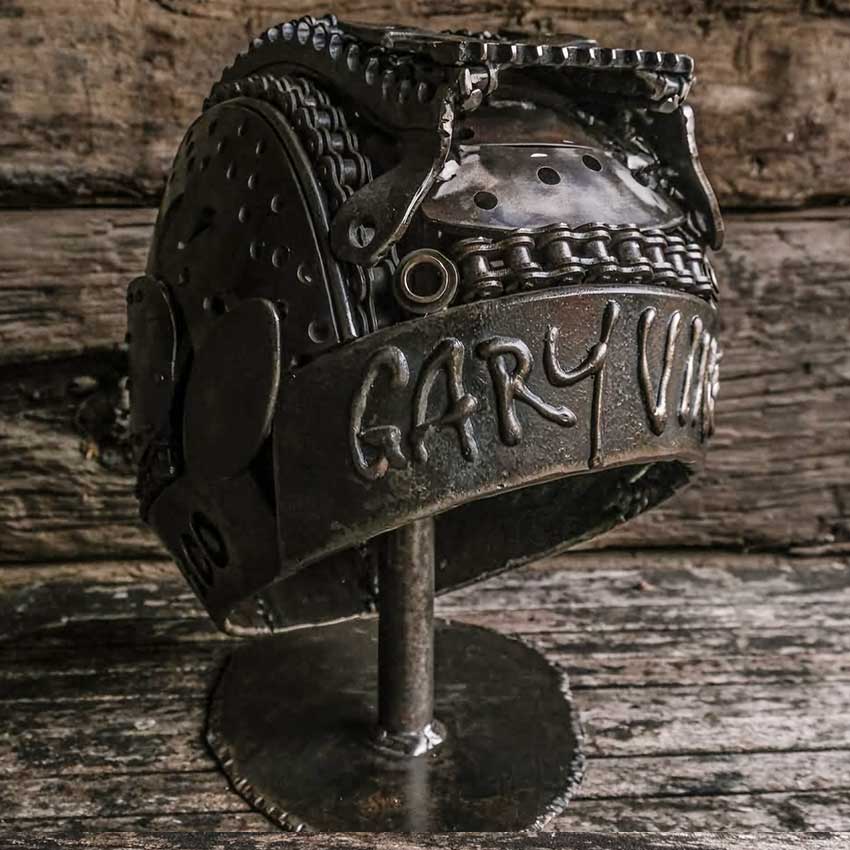
Gary Vines Memorial Helmet Sculpture

Project details

Commissioner: Uggly & Co
Artist: Alan Williams
Subject: Gary Vines
Project type: Memorial sculpture
Form: Racing helmet
Materials: Predominantly reclaimed motorcycle components, including fuel caps, chains and brake discs
Construction: Cut and welded motorcycle parts
Public setting: The Black Dub, Mile 9, Isle of Man TT course
Additional work: An identical memorial sculpture was made for Gary’s family
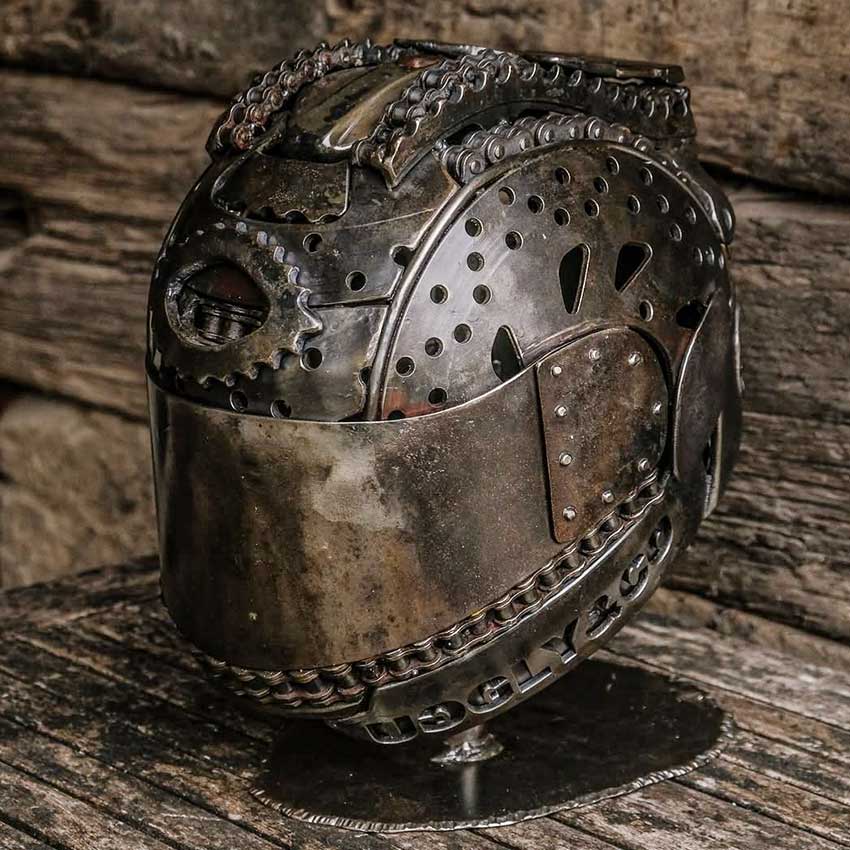
Gary Vines memorial helmet sculpture created by Alan Williams from reclaimed motorcycle parts

Uggly & Co commissioned Alan Williams to create a memorial sculpture for motorcycle racer Gary Vines, based on the form of Gary’s racing helmet.

Gary had been closely connected with Uggly & Co as one of the riders they supported. He was also a welder by trade, so Alan chose to build the helmet largely from motorcycle components rather than treating the metal as an anonymous material.

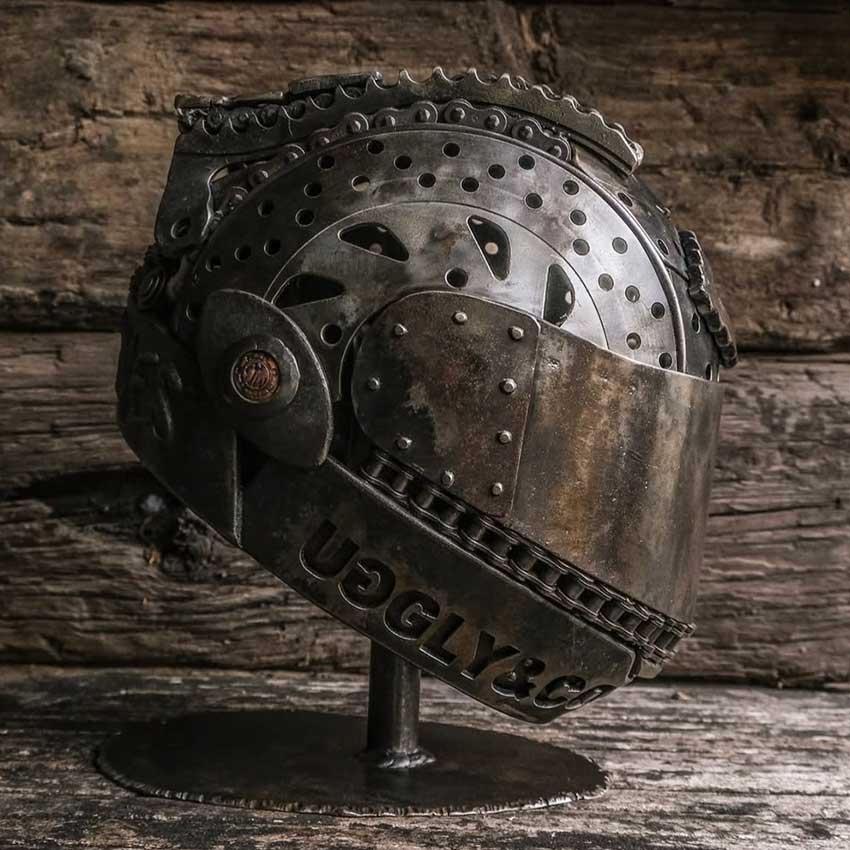
Around 90% of the finished sculpture is made from motorcycle parts. Fuel caps, chains, brake discs and other pieces of machinery were cut, positioned and welded together until the familiar shape of the racing helmet started to appear.

Two versions of the sculpture were made. One was intended for the Black Dub at Mile 9 of the Isle of Man TT course. The other was made for Gary’s family.
A memorial for Gary Vines

Gary Vines raced motorcycles on the Isle of Man and had a long association with Uggly & Co.

After his death during qualifying for the 2023 Manx Grand Prix, Uggly & Co approached Alan about making a memorial.

The racing helmet gave the sculpture a clear starting point. It was immediately connected with Gary without requiring a conventional portrait, and its shape also gave Alan plenty of opportunity to work with the mechanical material he already uses in his sculpture.

Gary’s background as a welder added another connection to how the piece would be made.

Gary Vines or racing helmet reference used for the memorial sculpture by Alan Williams
Construction of the Gary Vines racing helmet memorial sculpture by Alan Williams

Recreating the racing helmet

A helmet looks simple from a distance, but its shape depends on a series of fairly precise curves.

Alan needed to establish the dome of the helmet, the opening around the face and the lower edge before the individual motorcycle components could begin to take over the surface.

Those pieces had to work within the overall form rather than simply covering it.

A brake disc might provide a useful curve. A length of chain could follow an edge or bridge two areas. Fuel caps and other machined pieces brought their own circles, openings and raised surfaces.

The components remained recognisable, but their position within the helmet gave them another job.

Making the helmet from motorcycle parts

Approximately 90% of the sculpture was made from motorcycle components.

Alan used fuel caps, chains, brake discs and other salvaged parts, cutting and welding them together as the helmet developed.

Some pieces could be used almost as they were. Others needed cutting or adjusting before their shape would sit correctly against the neighbouring steel.

That process involved a fair amount of looking as well as fabrication.

Alan tried the parts against the helmet as he worked. If a piece distorted the line or sat too proud of the surface, it went back on the bench. Some components needed very little alteration because their existing shape already suited the section he was building.

Fuel caps chains brake discs and motorcycle components used in the Gary Vines memorial sculpture
Alan Williams welding motorcycle components into the Gary Vines memorial helmet sculpture

Building the form

The larger proportions had to remain clear while Alan worked with increasingly small pieces across the surface.

That becomes particularly important around the face opening and lower edge of the helmet, where small changes can alter the whole profile.

Alan welded the motorcycle parts into the developing structure, moving between the overall outline and the individual details as he worked.

The finished surface still shows what many of those objects were before they became part of the sculpture.

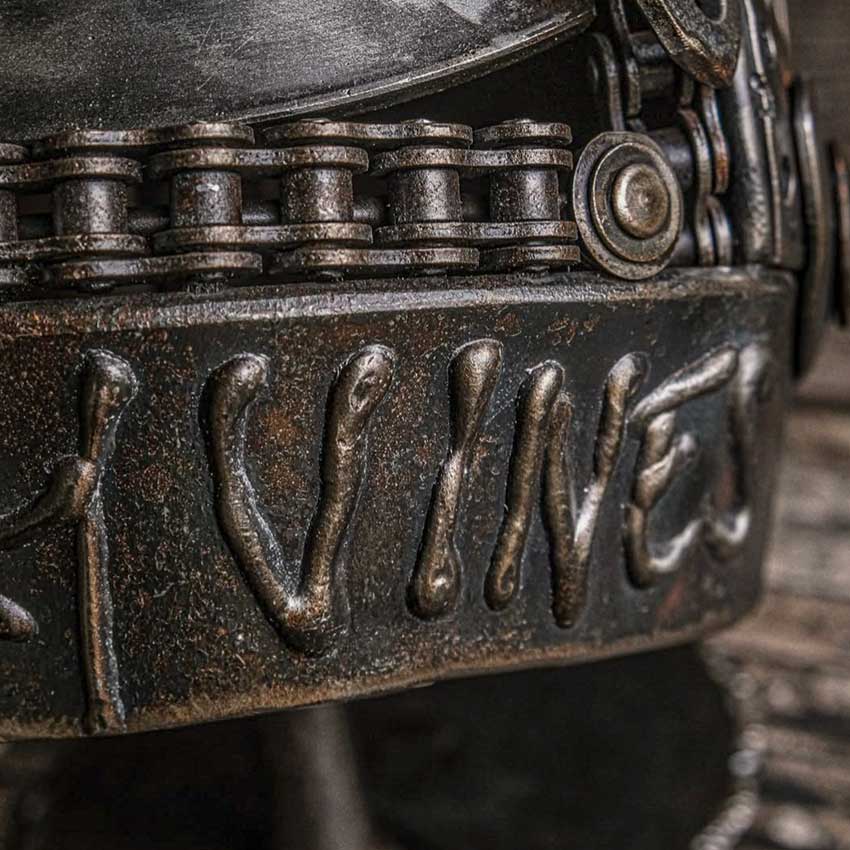
Chains remain chains. Brake discs retain their perforations and machined edges. Fuel caps are still easy to recognise when viewed closely.

Metal, motorcycles and Gary’s own trade

The choice of material had an obvious connection with Gary.

He raced motorcycles, worked on them and was a welder by trade.

Using motorcycle parts meant Alan could build that history directly into the object without needing to add a separate inscription or decorative explanation to every part of the sculpture.

The evidence is already there in the metal.

A worn mechanical component carries marks from the job it once performed. Within the helmet, those same parts become part of Gary’s racing identity.

Close detail of reclaimed motorcycle components in the Gary Vines memorial helmet sculpture
Two Gary Vines memorial helmet sculptures made by Alan Williams

Two memorial sculptures

Alan made two versions of the helmet.

One was intended for the Black Dub at Mile 9 of the Isle of Man TT course.

An identical sculpture was made for Gary’s family.

That gave the commission both a public and a private setting: one connected with the roads where Gary raced, the other remaining with the people closest to him.

The Black Dub

The Black Dub sits at Mile 9 of the Isle of Man TT course.

For a memorial connected with Gary’s racing, the location gives the sculpture a direct relationship with the landscape and roads where that part of his life took place.

The helmet is immediately understood in the road-racing context, while the motorcycle components become clearer when the work is seen at closer range.

Gary Vines memorial helmet sculpture at the Black Dub on the Isle of Man TT course
© Alan Williams Metal Sculpture Artist